Friday, June 28, 2019

They asked for a paper. . .

With apologies to C. S. Lewis (They Asked for a Paper: Papers and Addresses (London: Geoffrey Bles, 1962), let me tell you about some papers, read at two conferences. I have learned much from papers written for and read at a conference. Including those from Wheaton College Theology Conferences over the years. Each year, a topic is chosen and people invited. They convene and read to each other, discuss endlessly in session and in between; often far into the night.

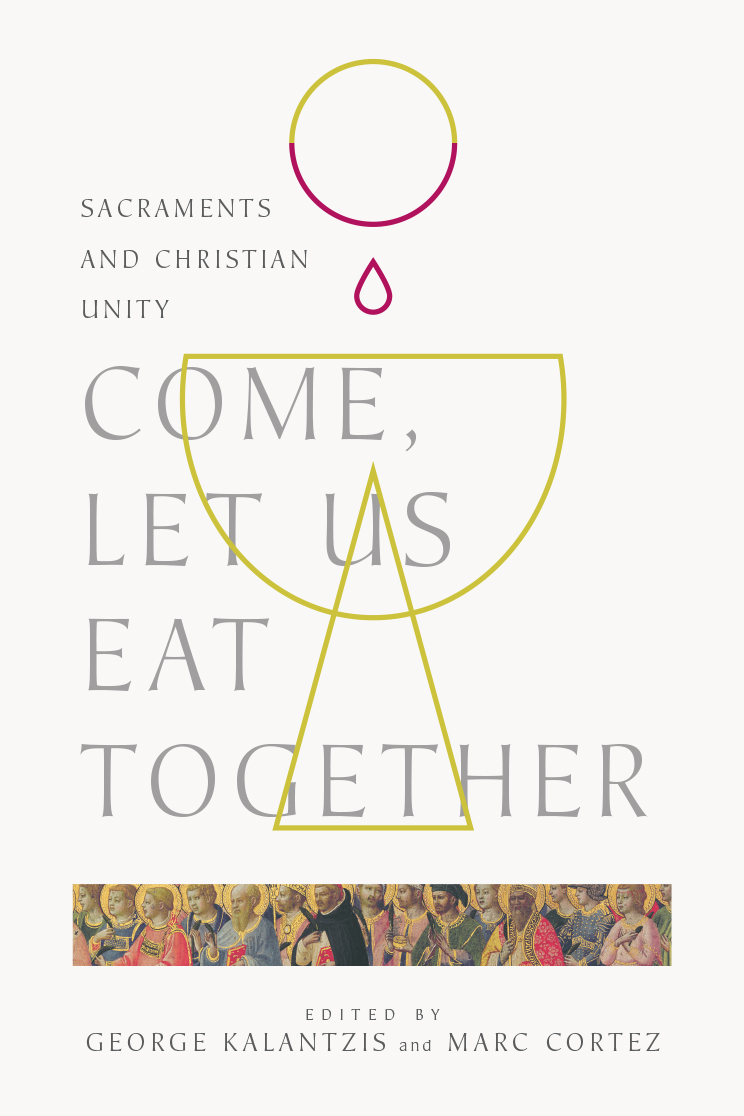
Come, Let Us Eat Together


First up: Come, Let Us Eat Together: Sacraments and Christian Unity , (www.ivpacademic.com), from 2017. A remarkably diverse, baker’s dozen scholars gathered to discuss the Lord’s Supper. Contributions from the Orthodox East, from Rome in the middle (geographically, perhaps theologically), some Anglicans, and various American Protestants. For a sample, let’s listen as Matthew Levering (University of St. Mary of the Lake) reads his paper, “The Eucharist, the Risen Lord, and the Road to Emmaus.” In Luke 24, “By teaching Cleopas and his companion how to read the Old Testament so as to recognize the necessity that the Messiah should suffer and then rise from the dead, the risen Jesus shows later believers one path for comprehending the truth of his resurrection: reading and understanding the Old Testament. In this essay, however, I will focus on a second path to which the risen Jesus directs believers: ‘the breaking of bread.’ ” (Lk 24:35)
After a careful exploration of Luke’s road to Emmaus story, interacting with other writers, as he comes to the conclusion of his essay, Levering turns to Christian unity and reads, “If the unity of Christians is to increase, who better to increase it than the risen Christ himself? And where could it be more fitting for this unity to be increased than in the Lord’s Supper or Eucharist, whose effect is to deepen the baptismal unity of ‘all the faithful in one body—the Church’ “?

One would love to have been in the room as others responded to Levering, eavesdropping on the
conversation. Would they have welcomed his enthusiasm for the unifying effect of the meal? Or,
would some still have reservations, shoring up walls instead of building bridges? A little of both
from what I see in the other essays. Luke 24 has become one of my favorite passages in teaching
about the meal. Levering’s treatment has given me added insights to share with my friends and
students.
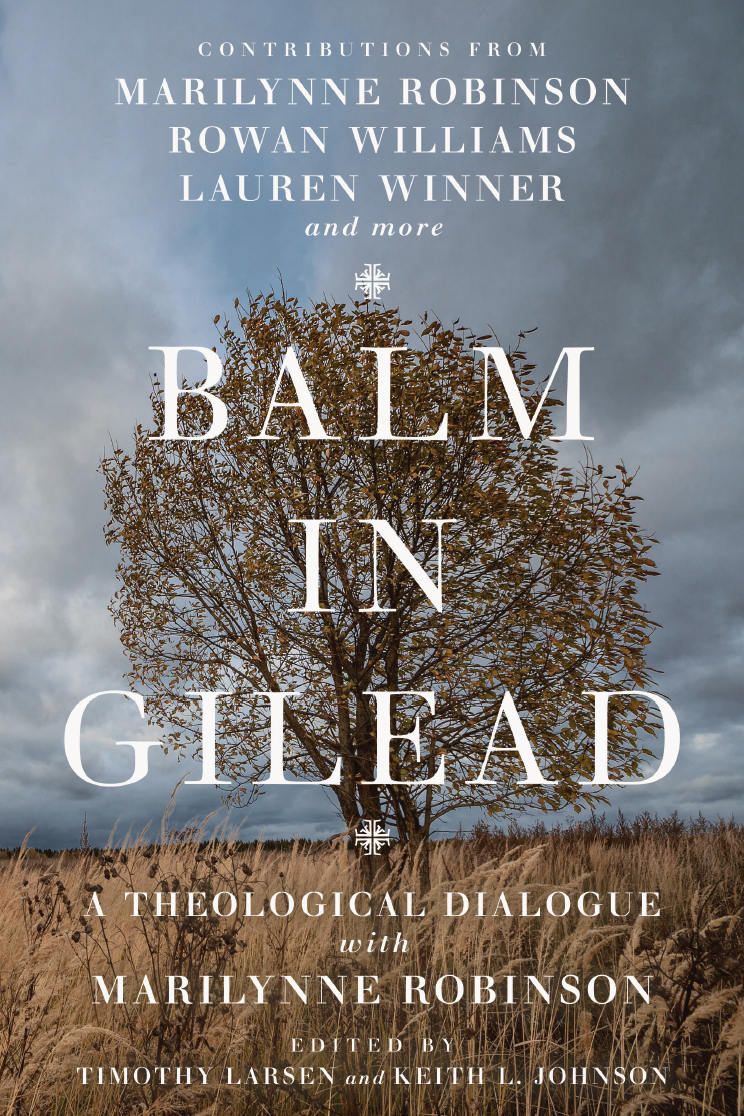
In 2018 the gathering turned to Marilynne Robinson and her fiction centered in the fictional Iowa town of Gilead and its pastor, John Ames; along with her essay collections. Including nine other writers, Robinson was there and joined the discussion. The resulting book is Balm in Gilead: A Theological Dialogue with Marilynne Robinson (www.ivpacademic.com).

I’ve read several of her books, both fiction and essays. The fiction embodies ideas that she finds important as she contemplates our culture; much like Wendell Berry’s fiction embodies his concerns for the environment. Since the book arrived, I’ve been reading the essays. Here’s what I found.

Robinson has been clear about her appreciation for John Calvin—a rarity among mainstream writers (a Pulitzer for her novel Gilead). So, of course this attracted some attention in Wheaton; a 22 page essay by Timothy George (Beeson Divinity School), a brief interchange in Robinson’s interview with Wheaton president Philip Ryken, and scattered comments in several other essays.

George focuses his essay on Robinson’s project of rescuing Calvin’s reputation. Robinson discovered Calvinism when she was assigned one of Jonathan Edwards’ writings in college. That turned her around and she started digging further into the tradition, back to Calvin, discovering along the way that the Geneva reformer is often slandered by scholars who haven’t read enough Calvin to know him. Now, Calvin shows up not only in her essays and lectures, but also in the protagonist in her fiction, the Rev. John Ames.

For instance, George quotes from Pastor Ames: “I fell to thinking of the passage in the Institutes
where it says the image of the Lord in anyone is more than reason enough to love him, and that
the Lord stands ready to take our enemies’ sins upon Himself It is a rejection of grace to hold our
enemy at fault. . . .I have probably preached on that a hundred times.” (Gilead, 189) George notes
that Robinson “acknowledges that Calvin teaches both. . .an exalted view of human beings made
in the image of God and the radicality of sin. Still, she concludes, ‘it is a grander thing altogether
to be a Calvinist sinner than a Freudian neurotic.’ ” (Balm in Gilead, 57)

Well, I’d better get back to reading the rest of the essays: “Thinking about preaching with
Marilynne Robinson” by Lauren Winter (Duke Divinity School); “Beyond Goodness: Gilead and
the Discovery of the Connections of Grace,” by Rowan Williams (Magdalen College, Cambridge)
among them.

—Larry Sibley, guest writer

Friday, June 14, 2019

Luther, Cranmer, Calvin, and much more

Reformation Worship: Liturgies from the Past for the PresentThomas Cranmer wanted to get the major reformers of his today together in one room to form a consensus about doctrine and worship. It never happened. But when you’re a couple of 21st century editors, you can do it. Just get their liturgies—17 of them from the 16th century—together between two covers, freshly translated into contemporary English; add some introductory comments to each—including charts showing the shape of each—and some general essays and it’s done! It’s called Reformation Worship: Liturgies from the Past for the Present edited by Jonathan Gibson and Mark Earngey (www.newgrowthpress.com ). Although you can see some differences (ones Cranmer hoped to resolve), you mostly notice the similarities. Lots of examples here for the 21st century church.

When Lois and I opened the package from the mail, we sat around and discussed it as we read. Listen in.

Lois: Wow, this is a heavy book (688 pages)! It begins with a Foreword by Sinclair Ferguson, who calls the reader to return to the Bible and the Reformation. The liturgies were written and shared by religious leaders from many countries and theologians, and Ferguson calls readers to use this collection “wisely and well,” even as a “benediction to the church.”

Larry: One of my favorites is John Calvin’s Form of Prayers that he used as a pastor in Geneva from 1542 until he died in 1664. The translation here is accessible for public reading of the exhortations, prayers, etc. Calvin’s sentences and paragraphs can be long and complex, but I think the average congregation would not get lost, especially if they had the text—adapted to fit the contemporary situation—in front of them and became familiar with it, almost memorize it from use. This is what gets the words “into the bone,” as they say, so that they can form the spiritual life of the believer. Calvin’s extended paraphrase of the Lord’s Prayer is especially good for shaping the prayer life of the worshiper. With Martin Luther’s Form of the Mass (1523) and German Mass (1526), the editors have included the music for chanting the Gospel and other standard texts, like the Sursum Corda; a definite plus!

Lois: I liked seeing Thomas Cranmer’s Book of Common Prayer (1549 and 1552) and comparing it with the 1979 revision that I often use. In 1979, some people were eager for a contemporary version and others wanted to keep the 1928 form. I like to imagine what it would have been like in 1549 when the first BCP was introduced. How would the people have adjusted to the prayers in English, instead of Latin? How long would it have taken for them to relax and enjoy the service?

Larry: I think it needs one more chapter. It’s great to have all these resources, but I wonder about how useful it would be for a busy pastor or a worship committee of lay folks without some hints about how to use it. For instance, if you’re Presbyterian, I’d take “what we’ve always done” and compare it with Calvin’s Form of Prayers. I’d look at the shape, the sequence of items, and notice how they fit together, play off each other to make a powerful and helpful guide for the congregation. Why did he place the intercessory prayer after the reading and preaching of the Word? What would happen if we did that instead of our usual placement earlier in the service? Would it be better as a response to the Word? Go one by one through the elements and ask similar questions compared to what you’re doing. Move slowly so that people can adjust and understand why. One congregation I know took 20 years to revamp their liturgy along Calvin’s lines. A chapter that leads the reader through this process step by step would be very helpful.

—Lois and Larry Sibley

Monday, July 30, 2018

Questions, Questions, and More Questions

(Lois invited Larry to contribute a review this time, here’s what he has to say.)

I lead a Bible Study Group most Sunday mornings, except during the summer. The group loves questions. After I finish with my questions, they start in with theirs and we go from there.

How about God asking the questions? Could they handle that? I’m about to find out next January when, with some of the same folks, I’ll use Dale and Sandy Larsen’s Questions God Asks, exploring nine questions God asks of characters in the Old Testament (www.ivpress.com). The Larsens write, “While each question is only one verse, the study unfolds the larger context of the question, including immediate circumstances, background, identity of the person being questioned, the person’s response, and the apparent results.”

 For instance, God asks Adam and Eve “Where are you?” They’re hiding as you will remember. Do folks hide from God today? Why? And does he come asking?

Or Jonah, in a fit because God is so merciful, hears “Is it right for you to be angry?” Well. . . . We too might get angry at God; perhaps.

This goes on with questions for Moses—“What’s that in your hand?;” Israel at the Red Sea—“Why are you crying out to me?;” Joshua—“What are you doing down on your face?;” Elijah—“What are you doing here?;” Israel again, now called Jacob in Isaiah—“Why do you complain, Jacob?;” Ezekiel—“Can these bones live?;” and Israel again, after the exile—God asks, “What about that nice house you live in while mine is in ruins?”

Come January, I’ll put some of these questions to the group and listen to their reactions—and get some questions back, no doubt. God’s questions cut to the quick, designed to help with self examination and spiritual renewal.

By the way, go back through this review and count the question marks. See how often we need to ask (and hear) questions?

—Larry Sibley

Thursday, January 11, 2018

Book by Book

The New York Times Book Review has a regular feature, By the Book. I've often thought it would be fun to riff on it. My professional specialties are liturgy and biblical studies, and I have varied avocational interests. As a guest on this blog, here's my take:

What books are on your night stand? Actually, it’s a footstool by my rocking/reading chair. Bit by bit, I’ve been reading Bobby Kennedy, by Larry Tye and Maine’s Golden Road, John Gould’s memoir about annual summer retreats in the Great Northen Maine wilderness. Over on the table across the room, are Wendell Berry’s Sabbath poems, This Day; often I read a few to start my Sunday.

Who is your favorite novelist of all time? Probably Flannery O’Connor. Wise Blood (1952), and The Violent Bear It Away (1960) showed that deep Christian commitment is no barrier to creative writing, indeed, it drives the best. Her letters (The Habit of Being, 1979) and her A Prayer Journal (2013) reveal the person who did the writing.

Who are your favorite writers working today? Wendell Berry, for fiction and poetry; Jeanne Murray Walker—Helping the Morning—for poetry; Marilynne Robinson for cultural comment; Jamie Smith on the competing loves in our world; Tom Wright for seeing the big picture in the biblical story; and Richard Hays for interpretive strategies.

What genres do you especially enjoy reading? I re-read three of Berry’s Port William novels this summer: The Memory of Old Jack, Jayber Crow, and Hannah Coulter. His Port William community in Kentucky takes me back to high school days in a hill farm community in Vermont. There’s more than nostalgia here, because Berry has tapped into the biblical motif of responsible care for the earth and its creatures; and the role of inter-generational families and the wider community in this caring.

Tell us about your favorite poetry books and short stories. For poetry, Robert Lowell, Elizabeth Bishop, William Carlos Williams, Marianne Moore, Wendell Berry and Jeannie Walker. Short story collections by Flannery O’Connor, The Complete Stories; Wendell Berry, That Distant Land and A Place in Time; and William Trevor, A Bit on the Side and Cheating at Canasta.

You’re hosting a literary dinner party. Which three writers are invited? I’d like to see John Calvin and Marilynne Robinson at the same table (since she quotes him from time to time), along with perhaps my friend Gordon Lathrop, a Lutheran writer. A potpourri of wit and dialog across the centuries.

What do you plan to read next? I’ve just begun Saving Images, by Lathrop and Awaiting the King, by Jamie Smith; so add those to the footstool. —Larry Sibley

Friday, December 29, 2017

Getting to the cure

Michael Emlet, in his new book, Descriptions and Prescriptions: A Biblical Perspective on Psychiatric Diagnoses and Medications (New Growth), understands and explains two big words that are important to those who are ministry people, and he applies these words and functions to those who need them.

These are the important words and terms: Psychiatric Diagnosis, and Psychoactive Medications. Emlet is on the faculty at Christian Counseling and Education (CCEF) in Glenside, PA, and he has excellent experience to discuss these important and often helpful words and terms.

Emlet divides his book into two sections, on Psychiatric Diagnosis and on Psychoactive Medications. There are twenty-two short chapters. He wrote his book primarily for helpers in the church, pastors, counselors, elders, deacons, youth workers; whoever needs this kind of help in their ministry will appreciate Michael Emlet and his book.

Along the way, he discusses specific hazards to spiritual growth, whether using diagnosis and medications as gifts or gods. Basic to his approach is his understanding of the human person with both a spiritual aspect and a physical aspect. Psychoactive Medications may be necessary and effective, but they will not address the person’s relationship to God. On the other hand, to treat a person’s struggles as only spiritual will deny the physical needs. God made us embodied spirits and both aspects will be involved in the counselor’s ministry.

One of the most helpful chapters in the book is the fourth, "The problems and pitfalls of psychiatric diagnosis: description not explanation." Emlet’s point is that a list of symptoms does not explain why they exist. An unacknowledged assumption sometimes is the key to the difference. He illustrates: "this assumption of biological root cause is widespread in our culture." This assumption can lead to normalizing behavior that stems from our fallen condition, treating some temptations as alternate lifestyles.

For example, assuming that various sexual orientations are biologically rooted and therefore normal (and should be expressed as alternate lifestyles) is very different from the biblical assumption that, whatever their biological or social source, some sexual expressions are sinful and therefore should, and can, be resisted, encouraged by the promise of the mercy and grace of God. Transformation of the whole person, including behavior, is the biblical goal.

Emlet writes, "we must acknowledge the complex interaction of multiple factors—physical, spiritual, relational, situational, and cultural—that combine in causative ways for a given individual." He proposes a balanced approach to helping someone who’s suffering emotionally. A psychiatric diagnosis might help, but it’s only a starting point towards healing, not a life sentence.


—Lois & Larry Sibley

Wednesday, August 16, 2017

Safeguarding Children

I almost cannot read this book.I may need to back-up and make a turn....
Yes, our churches, ministries, parents, teachers---so many adults, must know about terrible, abusive experiences children sometimes participate in for the sake of adults and children they love.

How can grown-ups do this to children? How can children participate...for those they love? Do many churches and ministries have policies to help control this, as soon as they know of such adult/childhood behavior? Or is it sometimes known and ignored?

This book: The Child Safeguarding Policy Guide, published by New Growth Press (NGP) "is a comprehensive, concrete resource that will aid churches in keeping children safe, holding offenders accountable, and witnessing their commitment to care for the least of these." This quote, and many like it, is accompanied by encouraging words, the stories and details of such happenings among our children and adults and how we can protect our children as we hear of incidents of abuse.

Perhaps we did not know. Perhaps we have not heard. Perhaps the children are afraid to tell us. But here we have an important Policy Guide for safety regarding our children.

Authors Basyle Tchividjian and Shira M. Berkovits and their team have provided us, parents, churches, ministries---all who need to know about these horrible demands sometimes forced on our children. Who knew? some may say. But now we can know and we know what to do to protect our children.

From Getting Started to using a Child Safeguarding Certification (p. 3), which provides necessary resources and support, and concludes with a chapter on Empowering Children, a good beginning. Educational programs for the children will help them learn what the rules are and how they can have "general body safety." An educator, even a parent, can encourage the children to become involved in their own education. For example, a youth group could have a discussion on "creating safe spaces" or, asking "what would make them feel safe" that could be helpful. Such conversations would help them feel safer, wherever they are.

I recommend this book. My children are all grown-up and past all the good and helpful ideas to be found in it. But I have grandchildren, even great-grandchildren who might like to talk with Grammie about people and spaces and kindness, and maybe even talk with the teacher.

loissibley@gmail.com
ireviewreligiousbks

Monday, July 24, 2017

Searching for hope..

Perhaps Author Albert Y. Hsu has written the book we have finally found: the right book for us, the one we have been looking for. We need it. Our whole family needs it. We grieve in the midst of our pain. Our precious grandson Jacob, killed himself, with a gun. Where would he even get a gun? We cannot believe it. He seemed so happy. He spent six years in the Air Force, then back to his classes in NOLA. He had many friends there and he was helping out at two churches near his apartment. Recently he sent a note to his mother, saying "Now I get it..." (about God). Later, the message came, on May 11, 2017....It's hard to say it....he killed hmself....hard to believe....

The first edition of Albert Hsu's book is called Grieving a Suicide, A loved one's search for comfort, answers, and hope. Published by InterVarsityPress, Hsu's book has been revised and expanded, at least twice, and a number of its readers share a paragraph or two, telling of their own painful experiences. Hsu has written his book in memory of his father, Terry Tsai-Yuan Hsu, 1939--1998, and he includes some of his family stories. Part 1 begins with a special word to begin each thought, such as denial, anger, shock, turmoil, lament, depression, and acceptance. In his Introduction, Hsu compares the weather in Minnesota, a state he knows "for frigid winters and heavy snowfall." And he tells survivers of suicide how "they could be caught in a winter storm of epic proportions in the road ahead, and he hopes his book will "guard your heart and soul during a time of terrible agony. May it provide you with some tracks to follow to make your way through."

Part  2 Includes Several Lingering Questions for the Reader:
            Why Did This Happen? Is Suicide the Unforgivable Sin? Where is God When It Hurts?

Part : 3  Life After Suicide; The Spirituality of Grief, The Healing Community, and Lessons.

If you are reading this, and trying to cope with the struggle, relax and have a pen and pencil ready. There is much to think about here and you will want to take notes.
Many thanks to Albert Hsu and to God. I have learned some important facts for grieving. May it help you all in your grieving.

 loissibley@ireviewreligiousbks