Tuesday, September 29, 2015

First Evangelical in America?

Author Rick Kennedy offers The First American Evangelical, A Short Life of Cotton Mather, and his book on Cotton Mather is part of an Eerdmans series called the Library of Religious Biography, edited by Mark A. Noll and available at www.eerdmans.com. Kennedy says that Cotton Mather was "a family man, a pastor, and a scholar," and he is "warmly remembered by Benjamin Franklin as a generous man, eager to do good."

During those 16--1700s in Boston, Increase Mather was pastor of the North Church and his son Cotton was his associate. They worked together though they were very different personalities. Increase tended to be strict and sometimes preached "harsh" sermons while Cotton "was softer," and he preached "more about Heaven's call than God's judgment." He called for a Bible-oriented day-by-day relationship with a remarkably active and communicative God."

In those days, as churches were formed, the people wanted a meetinghouse for worship, and a home for their pastor where the pastor had an office in his home, not an office in the church, as we are used to now. People with concerns came to talk with the pastor in his home office, sharing his Bible and his library as they discussed  whatever their concerns were. Cotton Mather shared and modeled what he called "all day long faith." Wherever he was, whatever he was doing, prayer became an important part of it. He "took his role as shepherd of a flock very seriously, as he organized and led many neighborhood groups that met on a regular schedule."

What made him the first in a long tradition of evangelical scholar-pastors resulted from the circumstances, says Kennedy. While New England became ready for a broader, more moderate Protestantism, there were also many people with an "evangelical interest," who needed leadership. Cotton Mather was not shy and he offered himself  "for the role of leader" for the evangelical group. And so he was, until his death in 1728. For those who want more, there are several pages of bibliography with suggestions.

---Lois Sibley,
ireviewreligiousbks

Tuesday, September 1, 2015

Helping Children Protect Their Bodies

God Made All of Me  is a new book to help children learn to protect themselves from becoming victims of sexual abuse. Published by New Growth Press, it is written by Justin and Lindsey Holcomb and illustrated by Trish Mahoney. It's really a book for parents with helpful words to use as they talk to their children about what to do if someone threatens them with "unwanted touch" or other suggestions. This one is especially aimed at children who are between ages two and eight, but it can certainly be used in talks with older children as well. It is very important that parents should gently introduce such a conversation, helping children understand that God made every part of their bodies and "every part is good and worth protecting."

The story is of a Mom and Dad and two small children, daughter Kayla and son David. One page has a quote from the Bible, Genesis 1:31, and the opposite page, a drawing of the family as they begin a conversation, Kayla saying: "God made me," and Mom answering: "When God made people, he called it very good." The text then says God made all things and offers illustrations of body parts like eyes, hair, arms, and nose. Dad joins in with "some parts of your body are for sharing and some parts are not for sharing." They talk about sharing hugs and kisses, or maybe high fives. And that's how they get to "private parts....that should be covered and not touched by other people." It's important that even small children should learn the correct names, like penis, vagina, bottom, and breasts.

If someone touches inapropriately, the children are taught to say, "No," and "go ask for help right away." Parents can help children to have a list of friends who might help them feel safe. Dad asks if they know the difference between secrets and surprises and Mom explains that secrets may make people feel confused or sad, so if they need help they must find a friend who will help them feel safe.

This book is good, should be helpful, if parents will begin the conversations....maybe older children will bring their concerns and questions to their parents.

---Lois Sibley,
ireviewreligiousbks


Friday, August 28, 2015

Pets and How They Teach Us...

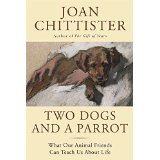
Two Dogs and a Parrot, What Our Animal Friends Can Teach Us About Life is a new book from Joan Chittister, published by Blue Bridge and available at www.bluebridgebooks.com. Chittester is a Benedictine nun in Erie, PA. One of her books, The Gift of Years (2008) was very popular. Her book called Happiness is another I appreciated and reviewed on this blog in 2013. Since 2008, she has written at least ten more books!

As busy as she is, who knew that Joan Chittester loves animals and often had a pet? In this book, she tells stories of three of her pets, an Irish Setter named Danny, a Golden Retriever named Duffy, and a Parrot named Lady Hildegard or Lady, as she was more popularly known. One at a time, each has seven mini-chapters in this book for their stories to be shared.

First came Danny, an Irish Setter described as "an absolute lexicon of lessons in life, the kind I was not expecting to learn. At least not from a dog." They went to a dog show and she expected Danny to perform as the other dogs did. Instead, she learned from Danny that "life is not about becoming someone else. Life is a matter of coming to be the best of what we are and allowing ourselves to enjoy being it, at the same time."

Next was Duffy, a Golden Retriever who was gentle, well-mannered, patient and quiet, also very large. Duffy "was a great, friendly bear of a dog." Love to Duffy "meant the willingness to do what he did not want to do, if it meant he could be with you." The nuns had their hands full with Duffy. When they went to the beach, he would not go into the water. Much disappointed, Chittester considered it the lesson of a lifetime as she wrote: "We can't make anyone else be what we want them to be---but we can let them be themselves. and love them for that and that alone."

And last but not least, we read about Lady. After the dogs died, Chittister remember that in her childhood her mother let her have a parakeet for a pet, and she thought, how about a parrot now? And so they had one and Lady taught them. One of the nuns tried to teach her to move quickly to prayer meeting by saying to Lady, "Step up." Repeatedly and not so kindly. Later, the parrot learned to say it to the nuns: "Step up," she barked, and not so kindly either.

In her Afterword, Chittister describes what a wonder it has been for the nuns to share their Monastery with these pets. There is also a poem Joan Chittister has written: "A Prayer for Animals."

---Lois Sibley            


Thursday, August 20, 2015

Walking with Jesus through His Word

Walking with Jesus through His Word, by Dennis E. Johnson has a subtitle as well: Discovering Christ in All the Scriptures, published by P&R Publishing. Johnson is professor of practical theology at Westminster Seminary California. He is an ordained minister in the Presbyterian Church in America (PCA) and author of many books and commentaries. Johnson claims that the sixty-six books of the Christian Scriptures, the Bible, "are bound together by a central theme, a single plotline, and a unique Hero, Jesus the Messiah." His book attempts to prove this theory, using the names and stories, and incidents that happened throughout early biblical history. You might expect him then to begin with Adam, but no, he begins with two disciples walking home from a difficult day in Jerusalem, when a young man joins them on their way. They don't recognize Jesus and he begins to tell them of "all the things beginning with Moses and all the Prophets that concerned himself" (Luke 24:27).

And so the journey begins. Using the metaphor of going on a journey, Johnson tells it all in six parts. In the last part he discusses how walking with Jesus through his Word changes us. And, it's quite amazing how he weaves in the many leaders and their stories, such as Moses, David, Jeremiah, "the Torah-loving man of Psalm 1," and others who served as prophets, priests, and kings.

In the end, Johnson names Jesus as the Final Prophet, Perfect Priest, and King of Kings. He remembers who they were in ancient Israel and how they now come under the guidance of Jesus: "the Son who reveals to us the will of God for our salvation; the priest who reconciles us to God; and the king, who rules over all." Johnson hopes walking through God's Word with Jesus, "we will find that our living Savior is moving us to marvel and worship, to hope and trust, to become more like him."

I wonder if Jesus expected that those who served in the synagogue and temple, and those who were disciples and new believers, both Jew and Gentile, would now come together as God's people. In his Gospel, Luke writes that Jesus said, "'I must proclaim the good news of the kingdom of God....' so he continued proclaiming the message of God in the synagogues" (Luke 4:43, 44). And in Luke 24:44, Luke writes that Jesus said to the disciples: "'everything written about me in the law of Moses, the prophets and the psalms must be fulfilled.' Then he opened their eyes to understand the Scriptures."

He must have been disappointed when the two groups did not and have not come together yet. Perhaps it will happen when he comes again! Be ready!

---Lois Sibley

Tuesday, July 28, 2015

Richard Twiss, Native American Leader

This is an unusual book. Author Richard Twiss spent many years, preaching, talking, writing, trying to convince both Native American people and whites descended from Colonial times that both groups worship the same God, whether he be called Creator or Jesus. Twiss died in 2013 and his wife, Katherine gave all his printed material to a group of friends who were eager to finish this book that Triss had begun earlier. It's called Rescuing the Gospel from the Cowboys, a Native American Expression of the Jesus Way, and is published by and available from ivpress.com.

Richard Twiss was born June 11, 1954 on the Rosebud Reservation in South Dakota. His family moved to Denver and then to Oregon, where Richard attended school. After graduating from high school, Richard moved back to Rosebud and he became involved in the American Indian Movement (AIM),strengthening his connections with other family members and deepening his appreciation for Lakota culture. One night during Richard's prayer, Creator responded to him and from that moment in 1974, Twiss was on a spiritual journey to live a meaningful life as a Lakota follower of the Jesus Way.

He and Katherine founded the nonprofit ministry of Wiconi International, through which they became known and "touched many thousands of people." Richard also founded or co-founded other organizations. In 2011 Richard earned his doctorate in missiology from Asbury Theological Seminary. He continued his teaching and writing careers and his first book, One Church, Many Tribes reached many people with the message of an inculturated faith in Jesus.

Twiss writes that "as Native people, we are in between the worlds of yesterday and where we will be, between traditional worldviews and western rationalism, between community and individuality, between spirituality and religion. We are not what we used to be and we are still becoming what we are not yet. In this in-between time we experience confusion, deep loss, fear, the unknown, searching, and despair." In Native terms, he says, "our circle is broken." He describes Native people as "living in two very different worlds." And it is crucial, he believes, for Native people to live biculturally in the urban culture. He uses many technical terms as he describes the history of the white and Native groups, what they did to each other, and where they are today. Much forgiveness is needed on both sides, in my opinion. And while Colonial Christianity continues to be impressed on the cultures of Native North America, "contextualization innovations are being introduced across Indian Country. The winds of change are blowing."

---Lois Sibley
ireviewreligiousbks

Friday, July 17, 2015

Luther, A Man of Wit and Wisdom...

Right off, author Carl R. Trueman admits he has "loved Luther almost since the moment I first grasped the gospel." Luther has been one of Trueman's "private theological companions," so he was pleased to be asked to write this volume, Luther on the Christian Life, Cross and Freedom, www.crossway.org, part of Crossway's series called Theologians on the Christian Life. Trueman, who is not a Lutheran but a church history professor at Westminster Seminary, Philadelphia, welcomed Robert Kolb of Concordia Seminary, in Saint Louis to write a Forward, and Martin E. Marty, Emeritus Professor at the University of Chicago, to write an Afterword. So let's begin...

Trueman's layout is a bit different for telling the story of Martin Luther's life. He begins with a summary of what's happening in the European world of church history in about 1508 and on, and how Luther fits in with his education, his family, his service to the church. Trueman says that as a theologian and pastor, Luther "was continually wrestling with how his theological insights connected to the lives and experiences of the people under his care." Trueman has long studied and taught on Luther and he believes there was a "personal passion" in Luther that finds "no obvious counterpart in the writings" of other significant theologians of his time.

Next, Trueman begins to describe and study some of the happenings in Luther's life, such as The Indulgence Controversy, The Diet of Worms in 1521, Wartburg in 1522 and Luther's translation of the New Testament into German, Wittenberg in 1525, his marriage to Katharine von Bora. Trueman calls us to think of Luther "as one of us." He says that "at a deeper level, we should see Luther in the way he wrestled with the deepest perennial questions of human, Christian existence." For example: "How can I find a gracious God? What and where is grace? In what does true happiness consist?"

After the section on Luther's life, there are more chapters on events that became important for Lutheranism, in many of which Luther was involved. He may be most notably remembered for his view of justification by grace through faith. He is also considered to be "the man who started the Reformation," with nailing his 95 theses to the church door in Wittenberg in 1517. Luther died in 1546 in Eisleben while on pastoral business. He has left  much of his writing for us to study and enjoy. I have a very nice copy of The Table Talk of Martin Luther, that I enjoy reading and which once belonged to the late Hal Rast, one of my favorite Lutherans.

---Lois Sibley


Tuesday, June 30, 2015

Two, Three, and Four...

As Alister McGrath continues his series called The Heart of Christian Faith, this second volume in the series is called The Living God, and is published by wjkbooks.com.  McGrath asks, "How do we know about God?" and he says that dictionaries offer definitions of  God as a "vague supreme being," He notes that Christian faith "stretches back to the dawn of civilization," and "we hold hands with millions who have known and loved our God and passed their wisdom on to us." Christians believe in the God of Abraham, of Isaac, and of Jacob (Exodus 3:16), and when we read of those "with whom we are linked by faith we are absorbing our own family history."

McGrath is Professor of Theology, Ministry, and Education and Head of the Centre for Theology, Religion, and Culture at King's College, London, and a prolific author. He claims that our God is "a personal God," an "almighty God," as well as being creator of the universe. He uses images as "windows into God," such as light, rock, shepherd, father, mother, king, and friend to describe the personal relationship between God and those who believe and have faith in him. He explains the doctrine of the Trinity as mystery, yes, reminding us of the one in three: God is creator, redeemer, and sustainer. The Holy Spirit, as the third person in the Trinity, is with us daily in our minds and hearts, leading, guiding, encouraging, and often leading us to worship and thanksgiving for our Triune God who loves us.

Volume three in this series is called Jesus Christ, and McGrath focuses on "what is, in many ways, the centrepiece of the Christian faith." He explores "more thoroughly what Christians mean when they declare that they believe in Jesus Christ." Volume four is called The Spirit of Grace, and as McGrath continues his teaching on the Holy Spirit, he brings in once again C. S. Lewis and Dorothy Sayers to share some of their opinions and writings.

While volumes three and four are now available, the fifth and final volume, titled The Christian Life and Hope, will be available from WestminsterJohnKnox in the Spring of 2016.

Lois Sibley,
ireviewreligiousbks