Monday, September 15, 2014

Phrases as little compositions...

What's in a Phrase? Pausing where Scripture gives you a pause is a new book from Marilyn Chandler McEntyre and published by Eerdmans, available at www.eerdmans.com. McEntyre caught me with the first sentence in her Introduction: “Phrases have lives of their own.” Yes, they do. And it’s often fun or maybe a challenge to stop and think about those few words and what they mean in that space and time. McEntyre calls them “little compositions that suggest and evoke and invite.” And she has been looking through the Scriptures to find phrases and think about what they mean in their particular context.

Author McEntyre is a fellow of the Gaede Institute for the Liberal Arts at Westmont College in California, and she teaches at UC Berkeley as well. She has other books and this one caught my eye and attention recently. She divides her book into three sections: Assurance; Invitation and Admonition; and Mystery and Surprise. There are 50 headline verses, each with pages of phrases to fathom.

McEntyre reminds us that the Benedictines called it lectio divina or holy reading, and when we stop and listen to a word or phrase, perhaps it is an act of faith, calling us to attention, and “we may assume,” she writes, that it is “a gift to be received.” Perhaps the Holy Spirit is about to teach us something that we need to know.

“Incline your ear, O Lord,” from Psalm 86 is the first phrase under the Assurance section.. She suggests that while we may be asking for answers to our prayer, we may have the answer in what we have been given already. And, “if we lift our gaze beyond anxieties, we may see that God has been listening.”

Under Invitation and Admonition, McEntyre reminds us of Micah 6:8 “...and what does the Lord require of you, but to do justice, and to love kindness, and to walk humbly with your God.” She offers examples of doing each of these as we think of our own possibilities.

The final section, Mystery and Surprise begins with “in the fullness of time,” as in Galatians 4:4, and continues with “Praise him, you highest heavens,” Ps. 148 (NRSV). We are reminded that the highest heavens are moving, the universe expanding, stars exploding..... “What do the heavens have to do with us and our praises?” asks McEntyre. First, the visible heavenly bodies are daily evidence of the order and power of the Creator; second, the heavens have given helpful, practical navigational guidance “to wise men in the desert and sailors on the sea”; and third, the importance of statements in Scripture, such as “God is love,” and “God is light.” Could all of these, and more, be affirmations of  God’s own praises beside our praises? There is much to think about here.      

—Lois Sibley

Thursday, September 4, 2014

C. S. Lewis Again...

C. S. Lewis & Mere Christianity by Paul McCusker and published jointly by Tyndale and Focus on the Family continues the popularity of Lewis and his many books. But here we learn more about  how he became involved with providing scripts for radio talks, as well as sets of series on religious subjects that were very popular with BBC radio listeners during World War II.

There is much detail here, focusing on C. S. Lewis (called Jack by author McCusker) and his family situation; his friendships with and support from Eric Fenn and James Welch of the BBC; as well as his academic teaching at Oxford, Magdalen College and Cambridge; his long friendships with fellow authors such as J. R. R. Tolkien, Charles Williams, and other members of The Inklings. Lewis and Dorothy Sayers were also friends and they appreciated each other’s writing.

The book is full of stories and incidents that tell us of Lewis’s care and concern for individuals as well as for his involvement in duty as a service person in both World Wars, I and II. At his home, the Kilns, they had evacuees from London staying with them during War II, as many families did. Usually three girls came together and stayed for a time. McCusker includes one of the girls’ appreciation for time she spent with Lewis and his family, when she was one of the “evacuees.”

Those familiar with Lewis’s history will recall that his mother died when he was nine years old, and he and his older brother Warnie were sent off to boarding school by their father. After their education years, both served in the military and both were authors during much of their adulthood. Among Jack’s many popular books are The Problem of Pain, The Screwtape Letters, The Chronicles of Narnia, and many others. Probably his most well-known book is Mere Christianity, most of which was first given as radio talks on BBC radio during WW II.

Lewis was a tutor and lecturer in English literature at Oxford. After his radio talks, he became quite well-known and was often invited to speak as an apologist for Christianity at meetings around the country. This was not appreciated by the Oxford dons, who thought he should stay in his own academic circle. Lewis described himself as a defender of the faith rather than “an apologist” and he encouraged his listeners to be the same.

McCusker includes so much of Lewis’s thoughts, decisions, actions, one wonders: how does he know this or that detail? Yet, it’s all there, in the vast amount of conversations, diaries, interviews, letters, speeches, books, referred to in the Notes section of this fascinating book.

—Lois Sibley


Thursday, August 14, 2014

"Wailing and Loud Lamentations..." with our prayers? (Matt. 2:18)

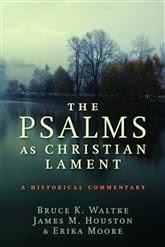
The Psalms as Christian Lament, a Historical Commentary published by Eerdmans, www.eerdmans.com is a mix of each of ten  “penitential psalms” with some history of what was happening when each was written and some advice from the authors as to how these psalms may ease us through our own pain and suffering. As we pray words of lament, we may also remember we are part of a whole, God’s people, who trust him while praising him and praying for his help and salvation. Our authors believe that lament is an important, though sometimes neglected, part of our prayers and they encourage readers to use lament as the psalmists did.

The authors are qualified to lead us on this journey: Bruce Waltke is Distinguished Professor of Old Testament at Knox Seminary in Fort Lauderdale and professor emeritus of biblical studies, Regent College, Vancouver; James Houston is founding principal and former chancellor of Regent College and their first professor of spiritual theology; Erika Moore is professor of Old Testament and Hebrew at Trinity School for Ministry, Ambridge, Pennsylvania.

The Psalms they study here are: 5, 6, 7, 32, 38, 39, 44, 102, 130, and 143. The authors have put together a kind of grid by which to measure each of the chosen Psalms. Each grid contains these four Parts: Voice of the Church; Voice of the Psalmist: Translation; Commentary; and Conclusion.

One of the things I especially like about this book is that it moves down through history, and theological differences are in the public eye. Opinions of various well-known theologians are introduced and critiqued as to where they fit into the over-all picture. They start with Ambrose and go on to Augustine, Erasmus, Gregory of Nyssa, Jerome, John Chrysostom, Origen, Martin Luther, John Calvin, Paul, and others. It reminds me of current discussions and differences among today’s prominent theologians, professors, clergy and lay, and how they all stir up the church from time to time.

There is so much to read and consider here, but these are a few of the gems that I hope to keep in mind and memory: “In sum, the psalm (32) is a unique mixture of penitence, wisdom, and praise. It mixes addresses to God...with addresses to the congregation.”
“Some pastoral theologians are now arguing, it is time we began to make more use of lament as a renewed focus for hope,” (p. 2).
“If, the Psalms are the mirror of the soul,” as Calvin wrote, then lament is a “major element.” In fact, one-third of the Psalter consists of  “lament psalms.” There are 42 individual laments, and 16 corporate laments. One writer says that, “the predominance of laments at the very heart of Israel’s prayers means that the problems that give rise to lament are “central to the life of faith,” and “intrinsic to the very nature of faith.” I’ll buy that....
Erasmus (1469–1536), in his Conclusion on Psalm 39 suggests there are three petitions there: “Desire impels us to pray, need urges us to cry out, while tears cause us to get what we want by force.” Pleading, but unanswered, the pray-er may begin to sing “a new song,” as in “I waited patiently for the Lord and he heard me.”
Erasmus chose to tread the via media in the midst of his culture and situation, and that caused him “to lament like the psalmist for all the blows he received from both Reformers and from the conservative Catholic leaders.” (p. 155)
In his reflection on Augustine and the Psalms, Rowan Williams steps in here (p. 174) to ask and answer: “How can we understand words that imply alienation from God when they occur on the lips of Jesus? Only by reading them as spoken by the whole Christ, that is, Christ with all the members of his body. He speaks for us, makes his own the protesting or troubled way of the human being, so that his own proper and perfect prayer to the father may become ours.” And our authors add: “The believing community today can appropriate this [or any] psalm because of the finished work of Christ.”
Thus, we may pray, as in Psalm 143:

“I AM,” hear my prayer! Listen to my cry for mercy!
  in your faithfulness answer me;....

—Lois Sibley
:

Tuesday, July 29, 2014

How to Share Your Faith...

Faith Is Like Skydiving is the title of Rick Mattson’s recent book from IVP, www.ivpress.com.  I think he means that if you want to share your faith in God, or anything, including skydiving, you better check out all the evidence before you get to the point of believing. Mattson started out 30 years ago as an IVCF staff worker at Macalester College in St. Paul, Minnesota. He is now an “apologetics specialist” for InterVarsity Christian Fellowship, and a frequent speaker on college campuses across the country. He can be reached at www.rickmattsonoutreach.com.

Mattson offers “memorable images for dialogue with seekers and skeptics.” His goal is to help readers “get out of the trap of being unprepared...for seekers and skeptics,” who come with their questions and objections to Christianity. He regrets times when he was not ready for the skeptic’s question, and lost the opportunity to offer the “good news.”

I perceive that Mattson is an extrovert. And he has practiced and he has prayed and he is ready whatever the question may be. He loves dialogue and he is definitely ready to take on anyone who wanders into his path. And he wants his readers to do this also. Easy for him to say. Introverts would have more hesitancy, I know, but still, we could take his advice, practice, and pray. He suggests: tell yourself the story of Jesus. Make and learn in your own words a 5-minute talk, a 10-minute talk, a 20-minute talk, pray and be ready for any opportunities the Holy Spirit may slip into your conversations with a neighbor or friend, or stranger, anyone who comes along.

Mattson divides his book into four parts: Making Your Case, Responding to Tough Questions, Science and Faith, and How-To’s. He concludes with a word of encouragement, reminding us that he has tried to offer a balance between “maximum preparation and maximum reliance on God’s Spirit when it comes to conversations with seekers and skeptics.” He reminds us also of his friend and colleague Jim Sire’s good advice: “....begin with the stories of Jesus because the best reason to believe in Christianity is Jesus.”

—Lois Sibley


Tuesday, July 15, 2014

One for kids and one for teens

Bless This Way is a fun-filled book of poems and songs by Anne E. Kitch  that will bring smiles to any reader, any age, though it’s designed for kids. Published by Morehouse at www.morehousepublishing.com, each double page is beautifully illustrated by Carolyn Digby Conahan. The poems are brief but memorable and easy to learn and remember. The pages of children having fun together are a good combination with the poems, expressing both joy and sadness. My favorites were Thanking, Walking with God, Singing, Quiet Time, and Safe in God’s Hands, but I like all of them really. I think children will, too.

Here’s a sample: God and I are going for a walk, We’ll pick up leaves  and step over puddles and probably jump in some....God and I are going for a talk....


Anglican Young People's Dictionary is an important book for older children and teens, especially for any who are becoming acolytes, or just for those sitting in the pews who wonder “what does that word mean?” Written by June A. English, with helpful illustrations by Dorothy Thompson Perez and again from Morehouse, the words are explained alphabetically. Author June English reminds us that many words used in the early church came from Latin and Greek. Some words still are remembered in that way, including “acolyte” which came from a Greek word meaning “one who serves.” I know some young acolytes who are pleased to be a part of that service.

Readers will learn the origin of many of the words in this dictionary, explaining the “why” and “how” of our use of them in our worship today. English notes that “on a deeper level, the words in this dictionary offer a history of the Anglican faith,” and for those who wonder, they will find helpful answers to their questions. Some of the words may seem ancient and cause us to wonder why we still use them, she says, but they “take us back to the time when Christ and his apostles walked the earth.” They “remind us of his message of hope” and they may serve as a key to young readers, helping them find a deeper understanding of their faith as they talk about it and practice it in the church and neighborhood where they are today.

—Lois Sibley


Wednesday, June 25, 2014

A New Idea for Daily Devotions

Let’s pretend, with author Donald K. McKim, that we are about to have Coffee with Calvin, Daily Devotions, published by WestminsterJohnKnox and available at www.wjkbooks.com. McKim has “long wanted to write a Calvin devotional book,” and now he has. Of course, we will also have to pretend Calvin can speak English with us. His first language was French, as he was born and brought up in France (1509–1564) and received much of his education there. He  knew Latin, Greek, and Hebrew, but we will converse with him and McKim in English, just for now.

Calvin attended the University of Paris and he probably joined with activities of some of the Reformers there in about 1533 or 34. He was a shy person, definitely an introvert, though he was very involved in sharing his ideas, both theological and cultural, and he found many ways to express them with pen and ink. In 1534, there were some difficulties between evangelicals and Catholics, and the evangelicals demonstrated their protests with placards. This upset King Francis I and an investigation began, which forced Calvin to leave Paris. Shortly after that, his rooms were searched and his papers were taken, with the result that we do not have much reliable information about Calvin’s life up to then. He has been described as “elusive,” because he did not share much about his personal life at any time.

But McKim tell us that Calvin “was an eminently practical theologian who believed theology should be not just a matter of the head, but of the heart and the hands as well. McKim provides 84 one-page devotional guides. Each one begins with a short paragraph from Calvin’s famous two-volume work, the Institutes of the Christian Religion. McKim has used the Latin, 1559 version, translated by Ford Lewis Battles, published by Westminster John Knox Press in 1960.

To give you an example: Prayer. Calvin says “The goal of prayer....namely, that hearts may be aroused and borne to God, whether to praise him or to beseech his help—from this we may understand that the essentials of prayer are set in the mind and heart, or rather that prayer itself is properly an emotion of the heart within, which is poured out and laid open before God, the searcher of hearts.” [cf. Rom. 8:27]. (Institutes 3.20.29) And McKim responds: “For all Calvin’s heavy theological discussions, the longest chapter in his Institutes is the one on prayer. Calvin sees prayer as absolutely essential for the Christian.”

Another of Calvin’s devotions is called: Doing Good Works, and Calvin says: “For we dream neither of a faith devoid of good works nor of a justification that stands without them....Faith and good works must cleave together.” (Institutes 3.16.1) And McKim reminds us: “Both Martin Luther and John Calvin emphasized that we are justified by faith alone and not by good works. This was a basic Protestant understanding during the sixteenth-century Reformation.” And he fills the page with other reminders, including this: “But while these Reformers stressed that salvation is by faith alone, they also recognized that justification is not by a faith that is alone. That is, those who are justified by faith will seek to do good works. This includes following God’s law and living by love.”

If you are looking for a new and interesting book of devotions, try Coffee with Calvin. It is filled with short paragraphs from John Calvin’s ideas and theology, as well as wisdom from Donald McKim who, in his comments and applications introduces readers to Calvin’s theological insights. McKim hopes that will help us discover that Calvin’s insights “strengthen, challenge, and nourish our Christian faith.” Highly recommended.

—Lois Sibley


.

Saturday, June 14, 2014

Joseph Haydn's Life and Work

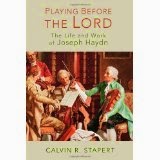
Playing Before the Lord, The Life and Work of Joseph Haydn by Calvin R. Stapert and published by Eerdmans, www.eerdmans.com is a treasure for both the professional musician and the ordinary person who knows a little about music from lessons learned earlier, and maybe from trying a bit of composing and writing poetry, but always eager to learn more. Stapert is professor emeritus of music at Calvin College in Michigan and he is more than qualified to teach and share his knowledge of music and Haydn.

Franz Joseph Haydn was baptized on April 1, 1732, perhaps born on March 31, 1732 (d.. 1809), in a village near the Austrian-Hungarian border. At age six, he was sent to live with the Franck family in a nearby town, where he would begin school. He was instructed in “reading, writing, catechism, singing, and almost all wind and string instruments, even in timpani.” Haydn said, “I shall owe it all to this man (Franck) even in my grave.” Haydn obviously had talent in music and soon (1740s) was sent to Vienna to be a choir boy.

Using dates and decades as subheads, Stapert follows Haydn from choir boy to freelance musician; music director in the 1750s; Vice-Kapellmeister and Kapellmeister at the Esterhazy Court in the town of Eisenstadt, Austria in 1761, where he describes himself as “composing, directs all music, helps rehearse everything, gives lessons, even tunes his own clavier.” Stapert analyzes how Haydn puts together the musical notes and phrases; how he plans for each instrument to join in at the appropriate moment, adding “solos integral to the whole.” He describes Haydn as a composer “with an unerring sense of musical form and an uncommon ability to recognize the developmental potential in simple musical materials.” And with diagrams and examples of notes on scales, Stapert shows the reader how Haydn did it.  

Stapert loves Haydn and his “huge and diverse output” of music, and Stapert’s book is biography, as well as a listener’s guide. At the end, there is an appendix outlining Haydn’s famous oratorio called The Creation; a glossary of technical terms; an impressive list of Haydn’s works, which include concertos, keyboard sonatas and trios, masses, operas, songs, string quartets, opus, symphonies, and more.

Haydn stayed with the Esterhazy Court for much of his adult life with trips back and forth to Paris, London, and Vienna, where he also composed, performed, and saw publishers and friends. He counted Mozart and Beethoven among his friends, lucky three! Haydn saw  his musical talent as a gift from God, and Stapert says that Haydn “often penned at the end of his scores: Laus Deo! – Praise to God!” Besides  The Creation, Haydn is famous for Stabat Mater, in honor of the Virgin Mary, still popular in music of the church year; and his symphonies called The Seasons, and Surprise. He is also known as composer of the tune for John Newton’s hymn, “Glorious Things of Thee Are Spoken”(1779). Stapert would like to see Haydn’s work become popular again and it may happen. Stapert’s book is an excellent way to learn more about Haydn and his music. May it encourage musicians and other readers to “play it again.......”

—Lois Sibley