Tuesday, July 15, 2014

One for kids and one for teens

Bless This Way is a fun-filled book of poems and songs by Anne E. Kitch  that will bring smiles to any reader, any age, though it’s designed for kids. Published by Morehouse at www.morehousepublishing.com, each double page is beautifully illustrated by Carolyn Digby Conahan. The poems are brief but memorable and easy to learn and remember. The pages of children having fun together are a good combination with the poems, expressing both joy and sadness. My favorites were Thanking, Walking with God, Singing, Quiet Time, and Safe in God’s Hands, but I like all of them really. I think children will, too.

Here’s a sample: God and I are going for a walk, We’ll pick up leaves  and step over puddles and probably jump in some....God and I are going for a talk....


Anglican Young People's Dictionary is an important book for older children and teens, especially for any who are becoming acolytes, or just for those sitting in the pews who wonder “what does that word mean?” Written by June A. English, with helpful illustrations by Dorothy Thompson Perez and again from Morehouse, the words are explained alphabetically. Author June English reminds us that many words used in the early church came from Latin and Greek. Some words still are remembered in that way, including “acolyte” which came from a Greek word meaning “one who serves.” I know some young acolytes who are pleased to be a part of that service.

Readers will learn the origin of many of the words in this dictionary, explaining the “why” and “how” of our use of them in our worship today. English notes that “on a deeper level, the words in this dictionary offer a history of the Anglican faith,” and for those who wonder, they will find helpful answers to their questions. Some of the words may seem ancient and cause us to wonder why we still use them, she says, but they “take us back to the time when Christ and his apostles walked the earth.” They “remind us of his message of hope” and they may serve as a key to young readers, helping them find a deeper understanding of their faith as they talk about it and practice it in the church and neighborhood where they are today.

—Lois Sibley


Wednesday, June 25, 2014

A New Idea for Daily Devotions

Let’s pretend, with author Donald K. McKim, that we are about to have Coffee with Calvin, Daily Devotions, published by WestminsterJohnKnox and available at www.wjkbooks.com. McKim has “long wanted to write a Calvin devotional book,” and now he has. Of course, we will also have to pretend Calvin can speak English with us. His first language was French, as he was born and brought up in France (1509–1564) and received much of his education there. He  knew Latin, Greek, and Hebrew, but we will converse with him and McKim in English, just for now.

Calvin attended the University of Paris and he probably joined with activities of some of the Reformers there in about 1533 or 34. He was a shy person, definitely an introvert, though he was very involved in sharing his ideas, both theological and cultural, and he found many ways to express them with pen and ink. In 1534, there were some difficulties between evangelicals and Catholics, and the evangelicals demonstrated their protests with placards. This upset King Francis I and an investigation began, which forced Calvin to leave Paris. Shortly after that, his rooms were searched and his papers were taken, with the result that we do not have much reliable information about Calvin’s life up to then. He has been described as “elusive,” because he did not share much about his personal life at any time.

But McKim tell us that Calvin “was an eminently practical theologian who believed theology should be not just a matter of the head, but of the heart and the hands as well. McKim provides 84 one-page devotional guides. Each one begins with a short paragraph from Calvin’s famous two-volume work, the Institutes of the Christian Religion. McKim has used the Latin, 1559 version, translated by Ford Lewis Battles, published by Westminster John Knox Press in 1960.

To give you an example: Prayer. Calvin says “The goal of prayer....namely, that hearts may be aroused and borne to God, whether to praise him or to beseech his help—from this we may understand that the essentials of prayer are set in the mind and heart, or rather that prayer itself is properly an emotion of the heart within, which is poured out and laid open before God, the searcher of hearts.” [cf. Rom. 8:27]. (Institutes 3.20.29) And McKim responds: “For all Calvin’s heavy theological discussions, the longest chapter in his Institutes is the one on prayer. Calvin sees prayer as absolutely essential for the Christian.”

Another of Calvin’s devotions is called: Doing Good Works, and Calvin says: “For we dream neither of a faith devoid of good works nor of a justification that stands without them....Faith and good works must cleave together.” (Institutes 3.16.1) And McKim reminds us: “Both Martin Luther and John Calvin emphasized that we are justified by faith alone and not by good works. This was a basic Protestant understanding during the sixteenth-century Reformation.” And he fills the page with other reminders, including this: “But while these Reformers stressed that salvation is by faith alone, they also recognized that justification is not by a faith that is alone. That is, those who are justified by faith will seek to do good works. This includes following God’s law and living by love.”

If you are looking for a new and interesting book of devotions, try Coffee with Calvin. It is filled with short paragraphs from John Calvin’s ideas and theology, as well as wisdom from Donald McKim who, in his comments and applications introduces readers to Calvin’s theological insights. McKim hopes that will help us discover that Calvin’s insights “strengthen, challenge, and nourish our Christian faith.” Highly recommended.

—Lois Sibley


.

Saturday, June 14, 2014

Joseph Haydn's Life and Work

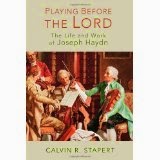
Playing Before the Lord, The Life and Work of Joseph Haydn by Calvin R. Stapert and published by Eerdmans, www.eerdmans.com is a treasure for both the professional musician and the ordinary person who knows a little about music from lessons learned earlier, and maybe from trying a bit of composing and writing poetry, but always eager to learn more. Stapert is professor emeritus of music at Calvin College in Michigan and he is more than qualified to teach and share his knowledge of music and Haydn.

Franz Joseph Haydn was baptized on April 1, 1732, perhaps born on March 31, 1732 (d.. 1809), in a village near the Austrian-Hungarian border. At age six, he was sent to live with the Franck family in a nearby town, where he would begin school. He was instructed in “reading, writing, catechism, singing, and almost all wind and string instruments, even in timpani.” Haydn said, “I shall owe it all to this man (Franck) even in my grave.” Haydn obviously had talent in music and soon (1740s) was sent to Vienna to be a choir boy.

Using dates and decades as subheads, Stapert follows Haydn from choir boy to freelance musician; music director in the 1750s; Vice-Kapellmeister and Kapellmeister at the Esterhazy Court in the town of Eisenstadt, Austria in 1761, where he describes himself as “composing, directs all music, helps rehearse everything, gives lessons, even tunes his own clavier.” Stapert analyzes how Haydn puts together the musical notes and phrases; how he plans for each instrument to join in at the appropriate moment, adding “solos integral to the whole.” He describes Haydn as a composer “with an unerring sense of musical form and an uncommon ability to recognize the developmental potential in simple musical materials.” And with diagrams and examples of notes on scales, Stapert shows the reader how Haydn did it.  

Stapert loves Haydn and his “huge and diverse output” of music, and Stapert’s book is biography, as well as a listener’s guide. At the end, there is an appendix outlining Haydn’s famous oratorio called The Creation; a glossary of technical terms; an impressive list of Haydn’s works, which include concertos, keyboard sonatas and trios, masses, operas, songs, string quartets, opus, symphonies, and more.

Haydn stayed with the Esterhazy Court for much of his adult life with trips back and forth to Paris, London, and Vienna, where he also composed, performed, and saw publishers and friends. He counted Mozart and Beethoven among his friends, lucky three! Haydn saw  his musical talent as a gift from God, and Stapert says that Haydn “often penned at the end of his scores: Laus Deo! – Praise to God!” Besides  The Creation, Haydn is famous for Stabat Mater, in honor of the Virgin Mary, still popular in music of the church year; and his symphonies called The Seasons, and Surprise. He is also known as composer of the tune for John Newton’s hymn, “Glorious Things of Thee Are Spoken”(1779). Stapert would like to see Haydn’s work become popular again and it may happen. Stapert’s book is an excellent way to learn more about Haydn and his music. May it encourage musicians and other readers to “play it again.......”

—Lois Sibley


Friday, May 30, 2014

Saying NO to the Culture

For the past 20 years or more, Walter Brueggemann has been known for his theological exegesis. In his many books and articles, he has been looking at the Bible as a theological document showing us what God is doing throughout history. In Sabbath as Resistance. Saying NO to the CULTURE OF NOW, Brueggemann writes about God’s people in the context of the cultures around them. He points out that the Bible has a distinct message and a different theology than the cultures in which God’s people find themselves. He compares Israel’s early Old Testament situation to the cultures the disciples lived in according to New Testament stories and incidents, and then to our situation in our cultures today.

Published by WestminsterJohnKnox, and available at www.wjkbooks.com, Brueggemann has more than 20 books with WJK. In this one, Chapter One is on Sabbath and the First Commandment, and in the next five chapters, he discusses resistance to anxiety, coercion, exclusivism, and multitasking (all concerns that sound familiar), and offers alternative ideas, followed by a final chapter on Sabbath and the Tenth Commandment.

It looks like people of both the Old and New Testaments had some of the same problems we are coping with today. And what did they do about it? And what should we do about our situation? Two of his key words are resistance and alternative, as he explains how the celebration of Sabbath can be an act of both resistance and alternative. Think of your own situation: is there tension in the family over resisting requirements of soccer practice on the Sabbath, for example?

Brueggemann says his book is for those who are feeling “weary and heavy laden,” because of the many requirements of our culture. He assures us that keeping the Sabbath is both resistance and  alternative to the demands of advertising and the commercialism surrounding us. He is beginning to think the fourth commandment on the Sabbath “is the most difficult and most urgent of the commandments in our society.”

I like the way Brueggemann brings together God’s people in both the Old Testament and the New, with our current times. He combines essential portions of the teachings of both Moses and Jesus, with references to Scripture and the Psalms, reminding us “do not be anxious....God provides what is needed.” As he says, Brueggemann’s book offers readers  “a journey from the world of commodity to the world of communion.” Recalling an old hymn, he urges us to “take time...Sabbath is taking time...to be holy.”

—Lois Sibley  

Friday, May 16, 2014

A Bio for the BCP


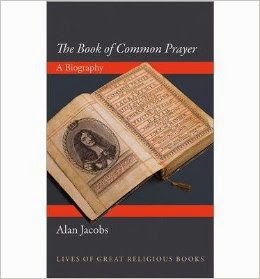
The Book of Common Prayer A Biography sounds like a book many of us would like to read. Written by Alan Jacobs, who is a professor at Baylor University in Texas and published by Princeton University Press at press.princeton.edu, this is part of their series called LIVES OF GREAT RELIGIOUS BOOKS. I didn't realize a book could have a bio, but this one has so much history packed around it that it needs a bio.

The story begins in 1543, with Archbishop Thomas Cranmer sitting in his study, looking around at his vast collection of books and thinking about how he might produce in English a book that would please not only King Henry VIII, whose moods were “hard to predict,” but would also be helpful to the people in the pews. Many of the people did not know Latin, which the priests had been using in their worship services for at least 1,000 years. To add to the challenges, in those days some of the people did not know how to read and write in English.

Cranmer chose to first produce a Litany in English, which was probably a wise decision. A litany consists of petitions to God, spoken by a priest, and affirmed by people in a brief refrain. First used in 1544, the Litany was part of church processions. After the opening words acknowledging God as Trinity, Cranmer included a prayer to God to keep Henry VIII safe as ruler, and went on with “various pieces,” and prayers on behalf of the people. This Litany was the beginning of The Book of Common Prayer, which is often referred to in the U.S. as the Prayer Book or the BCP.

For the next five years, Cranmer and his assistants worked on having one book in English with standard liturgies for worship in all the churches in the UK. It should include homilies, rites for Morning and Evening Prayer, prayers for the Daily Office, the administering of Communion and more. And this prayer book should partner with the Bible in English so that the people could be “stirred up to godliness.”

The first official copy of The Book of Common Prayer was printed in 1549 and there have been many revisions and updates since then. Professor Jacobs has followed carefully all that happened regarding the book and its changes. He is sensitive to the opinions of those on both sides of each controversy and his book is both informative and interesting. Be sure to read the final Notes section, lots of good info there, too.

Jacobs concludes: “Cranmer’s book and its direct successors, will always be acknowledged as historical documents of the first order, and masterpieces of English prose....but the goal—now as in 1549—is to be living words in the mouths of those who have a living faith.”

—Lois Sibley

Monday, April 28, 2014

The Poet's New Adventure

Luci Shaw is one of our favorite poets. We have followed her from Listen to the Green (1971) through A Widening Light (1984 in which she served as editor and poet), Polishing the Petoskey Stone (1990), and The Angles of Light (2000), as well as many other of her books of memorable poetry. At first, I thought her new book would be another enjoyable feast of poetry but the title invites us to an Adventure of Ascent, Field Notes from a Lifelong Journey, from ivpress.com/media. “Ah, Luci, what are you planning for us today,” I thought as I opened this new treasure. And I soon found that it is that, a treasure to keep near, and to think about in our own situations, challenges, joys and sorrows, as we continue on our journeys to the end of our lives here on earth and in future.

Now in her eighties and as active as ever, Luci has a goal. She plans to keep on growing and to share her adventures with us, to “act as a scout” actually, and to move through new territory and to report back to all of us so that we may know what it’s like for her and for us, what to expect, and how to deal with whatever comes to us. Her poetry is there among her thoughts and plans and sharing of stories. Her purpose is to “document her life as it travels toward the summit.” To be really honest and to “shed a clean light on what it’s like to be edging, inevitably, toward....?” Who knows what?

She says she will be asking lots of questions, lots of whys, whens, wheres and hows. Not new questions but she will ask for her own personal answers, thinking maybe we will profit from thinking about them as well. I admit I did learn from this dear poet and woman I call friend because of her words, her concerns, her openness, her sharing. Some of her questions I hadn’t even begun to think about nor try to answer. But, I will. Thanks, Luci.

Her thoughts on “downsizing” were helpful. It’s something most of us probably need to do at a certain time. Hard to do though. What to do with favorite stones and pottery and books? She reminds us that “where your treasure is, there will your heart be also” (Matt. 6:21). Yes, and those we love are really our treasures. And “they are not going away,” Luci says.

Luci is guessing “about future possibilities.” She feels gratitude for all she has been given, and she quotes “Bless the Lord, O my soul, and all that is within me, bless his holy name” (Ps. 103:1). Luci admits her “future is a surprise package full of questions without answers.” Her book ends with a poem, of course, as she asks: “when you go, will you go with a sizzle, or a sigh, will you leave with a bang, or quietly clinging, or will your bud of burning lift...to a wider light?”

—Lois Sibley


Friday, April 11, 2014

The Heart of Christian Faith

Alister E. McGrath is Professor of Theology, Ministry, and Education and Head of the Centre for Theology, Religion, and Culture at King’s College, London, and a prolific author. I have reviewed a number of his books over the last 20 years, and I have never been disappointed. Most recently, on November 1, 2013, on this blog, I reviewed McGrath’s bio of C. S. Lewis, published by Tyndale and called C. S. Lewis, a Life.

This time, McGrath is planning a five-book series to be called The Heart of Christian Faith. The first volume is called Faith and Creeds, A Guide for Study and Devotion, and is available now from www.wjkbooks.com. McGrath begins by asking a basic question: What do Christians believe and why? And what difference does it make? He plans to explore basic themes of a “simple and genuinely Christian faith,” and he is writing primarily for “ordinary “ Christians like you and me. I know his writing and I am already convinced that I will like what he says and what he is doing with this series. And you may want to pay attention, too.

In this first volume, he plans to draw on the earlier writing of “three of the great lay theologians of the twentieth century.” That would be, of course, G. K. Chesterton, C. S. Lewis, and Dorothy L. Sayers. But before he brings them in, he explains how he himself in his growing-up years, as one who loved science and still does, was drawn into an “inflexible atheism,” and he counted himself one of those “intellectual and cultural elite, who knew there was no God, no meaning, no purpose. Only fools believed otherwise,” he thought then.

But now he is learning to look at “the big picture,” to realize we are all on a journey, trying to make sense of the world we live in. Perhaps we could find a “core theme” that would help us realize that this world is not our home. “If nothing in this world really satisfies us,” maybe deep down we know “that our heart’s desire is anchored elsewhere.” Let’s look and see what we can discover, he says. Let’s look at the map, the lens and the light, he says, and see what we can learn. Then he talks about faith, belief, and creeds.

McGrath encourages us to “step into the big picture,” and ask ourselves: “Why do we think this is true; How can we make sense of it and best explain it; and What difference does it make in the way we live our lives? There is a lot to think about here. Alister McGrath is the guide we need as we consider together the opening words of the creeds: “I believe.... we believe.....” Come join us in McGrath’s new series, The Heart of Christian Faith. Volume 2 is called The Living God.

—Lois Sibley